When Andy Weir penned The Martian in 2011, his fictional botanist Mark Watney faced a seemingly impossible challenge: growing potatoes on Mars to survive until rescue. What began as brilliant science fiction has now sparked serious scientific inquiry into making plant habitats a reality for future interplanetary missions. The journey from fiction to feasibility reveals fascinating intersections between botany, engineering, and space science.
Modern research suggests Watney's makeshift potato farm wasn't entirely far-fetched. NASA's Advanced Plant Habitat on the International Space Station has already demonstrated that plants can complete their life cycle in microgravity. Scientists at the University of Arizona created a prototype lunar greenhouse showing crops like potatoes, wheat, and soybeans could potentially grow using recycled water and carbon dioxide. The European Space Agency's MELiSSA project has been perfecting closed-loop life support systems where plants regenerate air and produce food simultaneously.
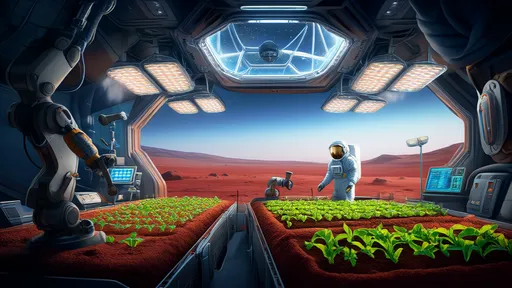
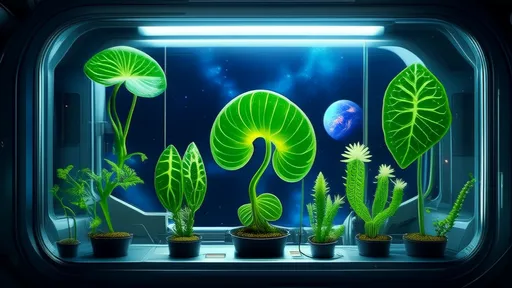
The real challenge lies in adapting these Earth-based systems for Martian conditions. Mars presents a trifecta of obstacles: extreme temperatures averaging -60°C, atmospheric pressure less than 1% of Earth's, and constant exposure to cosmic radiation. Current prototypes employ pressurized growth chambers with artificial lighting, temperature control, and hydroponic systems. NASA's Kennedy Space Center has developed "Veggie" units that could be scaled for Martian use, while private ventures like Interstellar Lab are creating modular biopod habitats.
Perhaps the most groundbreaking development comes from researchers at Wageningen University who successfully grew ten different crops in simulated Martian soil. Their work proves that with proper nutrient supplementation, the iron-rich regolith covering Mars could potentially support plant life. This discovery could dramatically reduce the need to transport Earth soil or hydroponic media, making sustainable agriculture on Mars more achievable.
From Prototype to Reality: The Engineering Hurdles
Translating these scientific breakthroughs into functional Martian greenhouses requires solving complex engineering problems. Power remains the primary constraint - growth chambers need substantial energy for lighting, temperature regulation, and water recycling. Solar panels may prove insufficient during Martian dust storms, prompting research into small nuclear reactors like NASA's Kilopower project as potential energy sources.
Water recovery presents another critical challenge. Systems must achieve near-perfect recycling rates, as transporting water from Earth would be impractical. Current ISS technology can reclaim about 90% of water through urine processing and humidity condensation, but Martian systems would need to push this closer to 99%. Researchers are investigating how plant transpiration could be integrated into water recovery systems to create a more efficient closed-loop.
Radiation shielding adds another layer of complexity. While Mars' thin atmosphere offers some protection compared to space, surface radiation levels remain dangerously high for both plants and humans. Proposed solutions range from burying habitats under Martian regolith to developing new lightweight shielding materials that could protect surface greenhouses without blocking essential sunlight.
The Psychological Dimension of Space Botany
Beyond pure survival, Martian plant habitats may serve crucial psychological functions for future crews. NASA's Human Research Program has documented how caring for plants boosts morale during long-duration space missions. The sight and smell of greenery could help combat the sensory deprivation astronauts would experience in Mars' barren landscape. Some designs even incorporate garden spaces as central features of Martian habitats to provide both food and psychological respite.
This therapeutic aspect has led to surprising collaborations between space agencies and landscape architects. Concepts like the "Growth Decks" proposed by Spacehabs combine food production with recreational gardening spaces. The European Space Agency has experimented with "sensory gardens" on Antarctic simulations, finding that crews exposed to plant environments showed lower stress markers and better team cohesion.
The Road Ahead: Timelines and Challenges
While significant progress has been made, experts estimate we're still a decade away from testing full-scale plant habitats on Mars. The upcoming Mars Sample Return mission may carry small biological experiments to study how organisms respond during the journey and in the Martian environment. Private initiatives like SpaceX's Starship could accelerate timelines by providing heavy-lift capacity for larger greenhouse modules.
The ultimate goal extends beyond mere survival - it's about creating self-sustaining ecosystems that could support permanent settlements. Researchers envision future Martian colonies with interconnected biomes where plants, microbes, and human waste products form a continuous cycle of renewal. This vision edges closer to reality with each passing year, proving that sometimes truth really does follow fiction.
As space agencies and private companies race toward crewed Mars missions, the humble potato plant from The Martian has become an unlikely symbol of interplanetary ambition. What began as a plot device in a bestselling novel may well become the cornerstone of humanity's first extraterrestrial colonies. The story of Martian agriculture is still being written, but each new breakthrough brings us closer to turning science fiction into science fact.

By /Aug 18, 2025
By /Aug 18, 2025

By /Aug 18, 2025
By /Aug 18, 2025

By /Aug 18, 2025
By /Aug 18, 2025

By /Aug 18, 2025

By /Aug 18, 2025
By /Aug 18, 2025
By /Aug 18, 2025

By /Aug 18, 2025
By /Aug 18, 2025
By /Aug 18, 2025

By /Aug 18, 2025
By /Aug 18, 2025
By /Aug 18, 2025
By /Aug 18, 2025

By /Aug 18, 2025

By /Aug 18, 2025

By /Aug 18, 2025
