The traditional biology classroom is undergoing a radical transformation as augmented reality (AR) technology breathes new life into one of science education’s most iconic—and controversial—exercises: frog dissection. For decades, students have donned gloves and picked up scalpels to explore amphibian anatomy, but ethical concerns, cost barriers, and logistical challenges have long plagued this practice. Now, a groundbreaking shift is underway as educators embrace AR-powered virtual dissection labs, offering an immersive, humane, and deeply engaging alternative that could redefine how anatomy is taught.
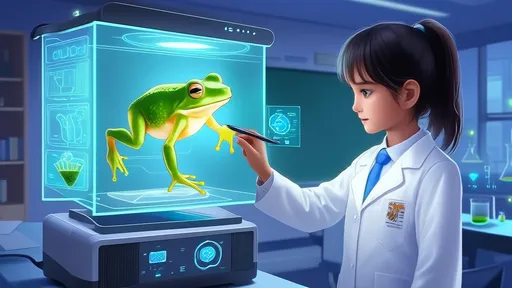
At the forefront of this movement is a wave of edtech startups and academic institutions collaborating to develop hyper-realistic AR applications. These platforms use 3D modeling and motion tracking to project life-sized, interactive frog specimens onto physical surfaces. Students wearing AR headsets or using tablet cameras can "lift" virtual organs, examine them from all angles, and even simulate incisions with finger gestures—all without touching formaldehyde or a single amphibian. The precision is staggering: vascular systems pulse with simulated blood flow, muscles twitch in response to nerve stimulation prompts, and layered anatomical structures reveal themselves with a tap.
What makes this revolution remarkable isn’t just its technological wizardry, but its pedagogical impact. Early adopters report that students using AR dissection tools demonstrate 23% higher retention rates compared to traditional methods, according to a Stanford Graduate School of Education study. The ability to undo mistakes, replay complex procedures, and access annotated 3D models appears to create deeper cognitive connections. "It’s like giving every student a personal anatomy tutor," remarks Dr. Elena Torres, a developmental biologist piloting the technology at UCLA. "They’re not just memorizing parts—they’re developing spatial reasoning skills crucial for future surgeons and researchers."
Beyond academic performance, the emotional dimension of this shift is profound. Many educators acknowledge how traditional dissection alienates vegetarian students, those with religious objections, or simply squeamish learners. AR labs eliminate this barrier while introducing unexpected benefits: visually impaired students can explore anatomy through haptic feedback gloves, and remote learners gain equal access to hands-on experiences. The technology also allows examination of pathological specimens—like frogs with congenital defects—that would be impossible to source physically.
Critics initially questioned whether virtual dissection could replicate the tactile feedback of real tissue, but advanced haptics are silencing doubts. Pressure-sensitive styluses now simulate the resistance of cutting through connective tissue, while thermal cues indicate organ temperatures. Some systems even incorporate olfactory components—releasing scents like isopropyl alcohol when students "clean" virtual tools—to enhance realism. This multisensory approach has convinced even skeptical teachers like James Whitaker, a 30-year veteran biology instructor: "Last semester, my AR lab students could identify the duodenum faster than my conventional class. That’s when I knew this wasn’t just a gimmick."
The environmental implications are equally compelling. Schools annually discard thousands of plastic-preserved specimens, each requiring hazardous chemicals for disposal. AR eliminates this waste stream while slashing costs—a single $200 headset replaces recurring $80 dissection kits. Rural schools in India and Africa are already leveraging smartphone-based AR to provide dissection experiences where refrigeration for specimens was previously unattainable.
As the technology matures, its applications are expanding. Medical schools now license the same platforms for human anatomy modules, and veterinary programs use AR to compare amphibian, avian, and mammalian systems side-by-side. The next frontier involves AI-guided adaptive learning, where the system adjusts complexity based on student performance—challenging advanced learners with rare anatomical variations while providing remedial tutorials for others.
This revolution does raise philosophical questions. Some argue that sanitizing dissection removes students’ confrontation with life and death—a rite of passage for many scientists. Others counter that AR fosters greater respect for life by eliminating unnecessary sacrifice. What’s undeniable is the technology’s potential to democratize science education globally. When a teenager in Mumbai can dissect a virtual frog identical to one at MIT, the playing field levels in unprecedented ways.
The implications extend beyond biology. AR dissection represents a test case for how immersive tech can transform stubbornly analog educational practices—from chemistry labs to archaeology fieldwork. As bandwidth improves and hardware costs drop, we may look back on formaldehyde-soaked dissection trays as relics of a bygone era. For now, the sight of students collaboratively "peeling back" holographic muscle layers with their fingertips offers a glimpse into a future where education isn’t just informative, but truly magical.

By /Aug 18, 2025
By /Aug 18, 2025
By /Aug 18, 2025
By /Aug 18, 2025

By /Aug 18, 2025

By /Aug 18, 2025
By /Aug 18, 2025

By /Aug 18, 2025
By /Aug 18, 2025
By /Aug 18, 2025
By /Aug 18, 2025

By /Aug 18, 2025
By /Aug 18, 2025
By /Aug 18, 2025

By /Aug 18, 2025

By /Aug 18, 2025
By /Aug 18, 2025

By /Aug 18, 2025

By /Aug 18, 2025
By /Aug 18, 2025
