Ferrari's stock performance has become a barometer for investor sentiment toward the auto industry's electric transition, reflecting a market increasingly skeptical of the smooth, inevitable shift that manufacturers have promised for years. While legacy automakers from Detroit to Stuttgart struggle with the practical realities of electrification, the Italian supercar manufacturer's shares have experienced significant volatility as investors recalibrate expectations about what the electric future truly means for different segments of the automotive landscape.
The traditional automotive giants find themselves navigating what industry analysts have begun calling "the electric valley of death" - that painful transition period where massive capital investments in electric vehicles have yet to yield profits, while their traditional combustion engine businesses face accelerating decline. General Motors, Ford, and Volkswagen have all pushed back electric vehicle targets in recent quarters, with executives openly acknowledging that consumer adoption is progressing slower than anticipated. The infrastructure challenges, from charging network reliability to grid capacity concerns, have proven more formidable than many projections suggested.
Meanwhile, Ferrari occupies a unique position in this landscape. The company's clientele represents perhaps the most insulated automotive demographic from the practical considerations that have slowed mainstream EV adoption. Ferrari buyers aren't typically concerned with charging infrastructure or range anxiety; their purchases represent emotional decisions, status symbols, and performance statements rather than practical transportation solutions. This distinction has become increasingly important as the market digests the reality that the electric transition will be segmented rather than uniform across all vehicle categories.
Ferrari's stock chart tells a story of evolving market perception. Throughout 2021 and early 2022, as electric vehicle enthusiasm reached its zenith, Ferrari shares underperformed the broader auto sector. Investors questioned whether a company so deeply associated with the theatricality of internal combustion could maintain its mystique in an electric world. The visceral experience of a Ferrari - the screaming V12, the mechanical symphony, the heritage of racing glory - seemed fundamentally at odds with the silent, instantaneous torque of electric powertrains.
This skepticism reached its peak when Ferrari announced its electrification strategy. The market initially punished the stock, fearing the company would lose its soul in the transition. But as 2023 progressed, a fascinating narrative shift occurred. Investors began recognizing that Ferrari's approach to electrification differed fundamentally from mass-market manufacturers. Rather than racing to produce affordable electric vehicles, Ferrari was taking its characteristic deliberate approach, focusing on how electrification could enhance rather than replace the emotional experience of driving a Ferrari.
The company's first fully electric model, expected in 2025, has been described by management not as a compliance vehicle or a concession to trends, but as "a true Ferrari" that will deliver emotions in ways only Ferrari can. This messaging has resonated with investors who now see Ferrari's electrification journey as additive rather than disruptive to its business model. The stock began outperforming, suggesting the market was coming to appreciate the distinction between forced transition and strategic evolution.
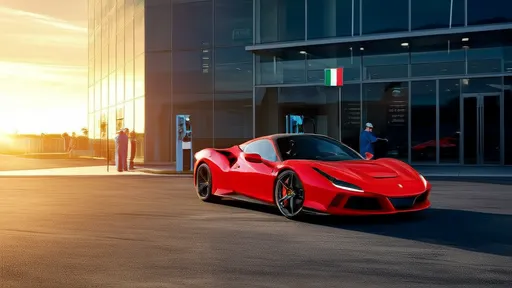
Recent quarterly results have reinforced this narrative. While mass-market automakers struggle with electric vehicle pricing power and profitability, Ferrari continues to demonstrate remarkable pricing authority. The company's hybrid models, particularly the SF90 Stradale and 296 GTB, have been commercial successes, commanding significant premiums over their combustion-engine predecessors while delivering performance that reinforces rather than compromises the brand's racing pedigree.
This pricing power reflects Ferrari's understanding of its unique market position. The company sells not just transportation but membership in an exclusive club, and its customers appear willing to pay substantial premiums for that privilege regardless of powertrain technology. This dynamic stands in stark contrast to the price wars erupting in the mass-market electric vehicle segment, where manufacturers are slashing prices to maintain volume, devastating margins in the process.
Ferrari's approach to the transition also highlights another critical advantage: scalability. While traditional manufacturers must retool entire factories and supply chains to produce electric vehicles at massive scale, Ferrari can approach electrification at its own pace, developing technologies specifically for low-volume, high-price applications. This allows the company to avoid the capital intensity that has strained its larger competitors, instead treating electrification as another engineering challenge to be mastered on its own terms.
The market's reassessment of Ferrari reflects a broader realization that the automotive industry's future may be more fragmented than previously assumed. The assumption that all vehicles would transition to electric power simultaneously is giving way to a more nuanced understanding that different vehicle segments and consumer demographics will adopt electric technology at different paces, if at all. Ferrari's business, built around emotional appeal rather than utilitarian transportation, may prove more resilient in this fragmented future.
Investors are also recognizing that Ferrari's value extends beyond its current product lineup. The company's brand equity, racing heritage, and customization business represent assets that may appreciate rather than depreciate as the automotive landscape changes. In a world where many cars become similar electric appliances, Ferrari's ability to deliver unique emotional experiences - whether through combustion, hybrid, or fully electric powertrains - may become increasingly valuable.
This isn't to suggest Ferrari faces no challenges. The company must navigate the same regulatory pressures as other manufacturers, particularly in Europe where emissions standards continue to tighten. Developing electric vehicles that meet Ferrari's performance standards while maintaining the emotional character customers expect represents a significant engineering challenge. And the company must carefully manage its transition to avoid alienating traditional customers while attracting new ones.
Nevertheless, Ferrari's recent stock performance suggests investors are gaining confidence in the company's ability to navigate these challenges. The market appears to be concluding that Ferrari's business model, built around exclusivity and emotion rather than volume and utility, may prove surprisingly well-suited to the automotive industry's electric transition. While mass-market manufacturers struggle with the economics of electrification, Ferrari's ability to command premium prices for premium experiences may provide the financial flexibility to transition on its own terms.
The story unfolding at Ferrari offers important lessons for investors watching the broader auto sector's transition. It suggests that business model matters more than technology, that brand equity can provide crucial insulation during periods of disruption, and that the most successful companies in the electric era may be those that understand their unique value proposition rather than those that race to adopt the latest technology. As the auto industry's electric dreams confront practical realities, Ferrari's journey may prove instructive for understanding which companies will thrive in the new automotive landscape.
Looking forward, Ferrari faces the delicate balancing act of preserving what makes the brand special while embracing the technologies that define automotive progress. The company's recent stock performance suggests investors are betting they can walk this tightrope successfully. In many ways, Ferrari has become a test case for whether automotive passion can survive the transition to electric power, and so far, the market appears to be voting yes.
The automotive industry's electric transition was always going to be messy, but few predicted it would create such clear winners and losers so early in the process. Ferrari's recent strength amid broader auto sector weakness suggests that in the electric future, as in the combustion past, some rules of business remain unchanged: strong brands with pricing power and clear understanding of their customers tend to navigate disruption better than those competing primarily on technology or price. The prancing horse appears to be proving that some things still can't be electrified - like the power of a dream.

By /Oct 11, 2025

By /Oct 11, 2025

By /Oct 11, 2025

By /Oct 11, 2025
By /Oct 11, 2025

By /Oct 11, 2025
By /Oct 11, 2025

By /Oct 11, 2025

By /Oct 11, 2025
By /Oct 11, 2025

By Ryan Martin/Oct 11, 2025

By /Oct 11, 2025

By /Oct 11, 2025

By /Oct 11, 2025

By /Oct 11, 2025

By /Oct 11, 2025

By /Oct 11, 2025

By /Oct 11, 2025

By /Oct 11, 2025

By /Oct 11, 2025
