The global race for AI infrastructure is accelerating at a pace that has caught even the most optimistic industry observers by surprise. What began as a technological competition has evolved into a full-scale geopolitical struggle, with nations and corporations pouring unprecedented resources into building the computational backbone required to dominate the artificial intelligence era. At the heart of this contest lie two critical components: advanced semiconductors and massive-scale data centers. These are not merely elements of technological infrastructure; they have become the fundamental chips up on which future economic and strategic power will be built.
The semiconductor, particularly the specialized AI chip, has emerged as the modern equivalent of oil—a resource so essential that control over its production and supply chains dictates global influence. Companies like NVIDIA, AMD, and Intel in the United States, alongside emerging challengers in Asia and Europe, are engaged in a relentless innovation cycle. Each new generation of chips promises exponential gains in processing power while grappling with the physical limitations of silicon. The competition has extended beyond raw computational performance to encompass energy efficiency, thermal management, and specialized architectures designed for specific AI workloads, from large language model training to real-time inference at the edge.
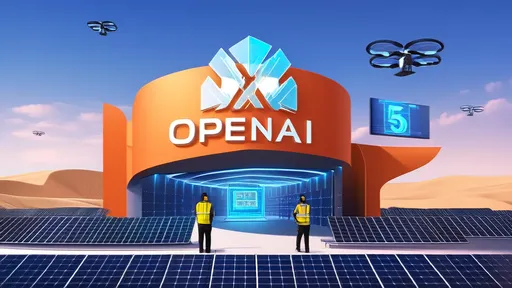
Meanwhile, the data center landscape is undergoing a radical transformation. The traditional model of centralized computing facilities is giving way to distributed, hyperscale architectures that span continents. These are not the data centers of a decade ago; they are AI factories, purpose-built to process the unimaginable volumes of data required to train and run sophisticated AI models. Their location, design, and power requirements have become strategic decisions, influenced by factors ranging from the availability of renewable energy and cooling resources to geopolitical stability and data sovereignty laws. The scale is staggering, with single facilities now consuming more power than medium-sized cities, representing both a monumental engineering achievement and a significant environmental challenge.
The United States, through a combination of private sector dynamism and strategic government intervention, currently holds a leading position. The CHIPS and Science Act has funneled billions into domestic semiconductor manufacturing, aiming to reduce reliance on Asian foundries. American tech giants—Google, Microsoft, Amazon, and Meta—are deploying capital at a scale rarely seen in corporate history, building data centers at a pace that is straining global supply chains for everything from transformers to specialized cooling systems. Their vertically integrated approach, where they design custom AI chips and build the infrastructure to run them, creates a powerful, self-reinforcing ecosystem.
However, China is pursuing a different but equally determined path. Faced with stringent export controls on advanced chips and manufacturing equipment, the country is embarking on a massive import substitution campaign. Billions in state-led investment are flowing into domestic champions like SMIC and Huawei, aiming to build a self-sufficient semiconductor industry from the ground up. While trailing in cutting-edge process technology, China's sheer market size, state support, and focus on mature-node chips for a wide array of AI applications make it a formidable and resilient competitor. Its data center build-out, though sometimes less publicized, is proceeding at a breathtaking scale, often integrated with national industrial policy and smart city initiatives.
This bipolar competition should not obscure the significant plays being made elsewhere. The European Union, awakened to its strategic dependencies, has launched its own Chips Act, seeking to double its global market share by 2030. Taiwan and South Korea, home to the world's most advanced semiconductor foundries, TSMC and Samsung, are navigating an increasingly complex geopolitical landscape, balancing their roles as critical global suppliers with the pressures of great power competition. Japan is making a notable comeback, leveraging its historical strengths in materials and equipment to reclaim a central role in the supply chain. Smaller nations, from Singapore to Israel, are carving out niches in specialized chip design or novel AI hardware architectures.
The implications of this infrastructure race extend far beyond technology. It is reshaping global trade, alliance structures, and national security doctrines. Control over the AI supply chain is now considered a core national interest. Export controls on chips and manufacturing tools have become potent weapons of statecraft. The very geography of innovation is shifting, influenced by subsidies, talent pools, and access to energy. This is creating a new form of technological sovereignty, where a nation's ability to develop and deploy AI independently is seen as paramount to its economic resilience and strategic autonomy.
For the global tech industry, the infrastructure race is creating both immense opportunities and profound challenges. The capital expenditure required to stay competitive is soaring, leading to industry consolidation and powerful network effects that favor a handful of hyperscalers. At the same time, it is driving a new wave of innovation in areas like chiplet design, optical interconnects, liquid cooling, and modular data center construction. The entire digital economy is being rebuilt on this new AI-centric foundation, forcing every company, in every sector, to reconsider its technological strategy.
Looking ahead, the trajectory of the AI infrastructure race points toward even greater complexity. The next frontier involves overcoming the looming physical limits of traditional silicon with research into novel materials, neuromorphic computing, and quantum-inspired architectures. The industry is also grappling with the sustainability crisis, as the energy demands of AI threaten to outpace the world's capacity to generate clean power. The winners of this long-term contest will not necessarily be those with the fastest single chip, but those who can build the most efficient, scalable, and resilient end-to-end systems, from the atomic structure of a transistor to the global network of data factories.
In conclusion, the global competition for AI supremacy is, at its core, a competition for physical infrastructure. The chips and data centers being built today are the engines of the 21st-century economy and the determinants of future geopolitical influence. This race is accelerating technological progress, but it is also fragmenting the global technology ecosystem and introducing new risks and tensions. How this contest evolves—whether it leads to a more multipolar technological landscape or a deepening bifurcation—will fundamentally shape the course of the coming decades, defining the balance of power and the very nature of innovation in the age of artificial intelligence.

By /Oct 11, 2025

By /Oct 11, 2025

By /Oct 11, 2025

By /Oct 11, 2025

By /Oct 11, 2025

By /Oct 11, 2025
By /Oct 11, 2025

By /Oct 11, 2025

By /Oct 11, 2025
By /Oct 11, 2025

By Ryan Martin/Oct 11, 2025

By /Oct 11, 2025

By /Oct 11, 2025

By /Oct 11, 2025

By /Oct 11, 2025

By /Oct 11, 2025

By /Oct 11, 2025

By /Oct 11, 2025

By /Oct 11, 2025

By /Oct 11, 2025
